Screw anatomy
What is screw anatomy? A screw is a helical fastener made of distinct regions: the head (bearing surface and drive interface), optional shank, thread (helical engagement), and often a point. Together they determine how torque is applied, how load is distributed, and how the fastener engages the joint.
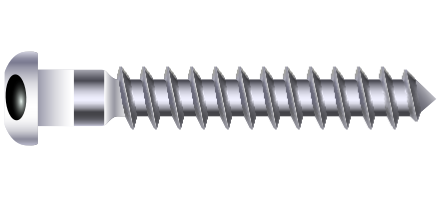
Head
Bearing surface & drive
Shank
Unthreaded body (if present)
Thread
Helical engagement
Point
Starts & centers the screw
Head
Bears clamp load and holds the drive recess or external wrenching flats.
Identify style separately from thread—see head types.
Shank
Unthreaded body under the head; provides alignment and shear area on some joints.
Fully threaded fasteners may omit a long smooth shank.
Thread
Helical form that converts rotation into axial clamp force; defined by diameter, pitch or TPI, and class.
See thread types for families (metric, unified, etc.).
Point
Starting geometry: blunt machine point, gimlet, or specialized cutting/drilling tips.
Compare self-tapping vs self-drilling.
Region comparison
What each region contributes in service—not a substitute for a drawing or standard, but a quick mental model.
| Region | Primary job | What to measure / note |
|---|---|---|
| Head | Bearing, drive, sometimes sealing | Head style, drive type, diameter across flats (hex) |
| Shank | Alignment, shear path (if unthreaded) | Shank diameter vs. thread major |
| Thread | Clamp load, engagement | Major Ø, pitch/TPI, length of engagement |
| Point | Starting, piercing, chip control | Point type vs. pilot hole requirement |
Types and naming
Machine screws typically have machine points and mate with nuts or tapped holes. Cap screws often imply a cylindrical head with hex socket. Self-tapping and self-drilling variants modify the point and thread form for sheet and steel construction—see the dedicated reference page.
Applications
Use anatomy as a checklist: once you know head and drive, measure thread for interchange; verify point matches the material and installation method.
Use with BoltLab
Tools
Charts
Guide
FAQ
What are the main parts of a screw?
Most machine-style screws include a head (bearing and drive), an optional unthreaded shank, a threaded section, and often a point.
What is the difference between the shank and the thread?
The shank is the smooth section under the head. The thread is the helical ridge that engages the mating feature.
How do I measure screw size?
Measure major diameter and pitch (or TPI), then use the Thread Identifier.
Is the head the same as the drive?
No—the head is the bearing region and envelope; the drive is the torque interface (recess or external hex).
When does the point style matter?
For starting behavior and whether the screw drills or cuts its own hole—see self-tapping vs self-drilling.